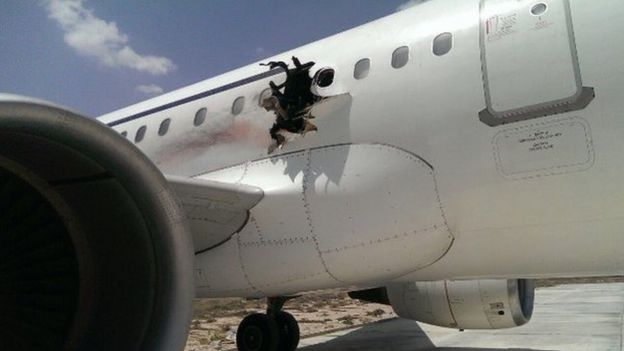
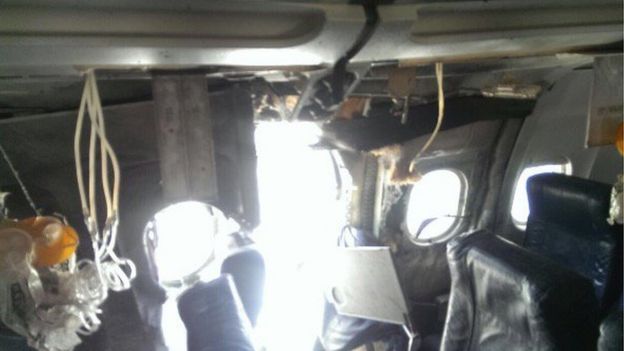
A blast that punched a large hole in the fuselage of a passenger plane at Somalia's Mogadishu airport on Tuesday was caused by a bomb, officials say.
"It was a bomb that exploded in the Daallo Airlines flight. It was meant to kill all aboard," Transport Minister Ali Ahmed Jamac said.
One passenger was sucked out of the plane and died, and two other passengers were injured.
The Djibouti-bound Airbus 321 was forced to make an emergency landing.
Some reports suggest that an explosive device may have been hidden inside a laptop of one of the passengers.
The blast happened shortly after take-off from the Somali capital.
No militant group has so far said it was behind the explosion.
In a statement shortly after the incident, Daallo Airlines said an investigation was launched by Somalia's Civil Aviation Authority, as well as a technical team from the aircraft's owners and its manufacturers, Airbus.Mohamed Hassan, a police officer in Balad, an agricultural town 30km (18 miles) north of Mogadishu, said residents had found the body of a man who might have fallen from the plane.
Serbian captain Vlatko Vodopivec said at the time he and others were told the explosion was caused by a bomb.
"It was my first bomb; I hope it will be the last,'' Mr Vodopivec said. He said the blast happened when the plane was at around 11,000ft (3,350m).
"It would have been much worse if we were higher," he added.
Daallo Airlines flies regularly from its base in Dubai to Somalia and Djibouti.
Somalia is battling militant Islamist group al-Shabab that has been carrying out deadly attacks in its quest to establish an Islamic state.
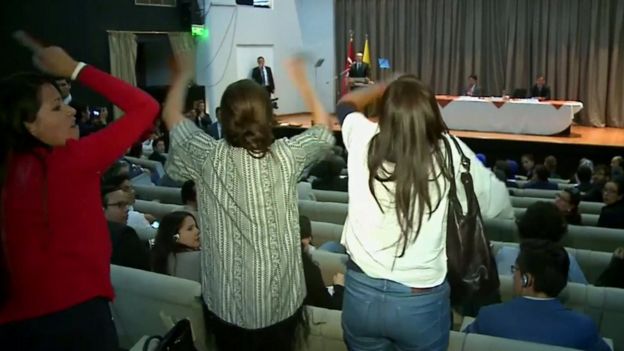
Ecuador has protested to Turkey over an incident in which demonstrators were violently ejected during a speech by visiting Turkish President Recep Tayyip Erdogan in the capital, Quito.
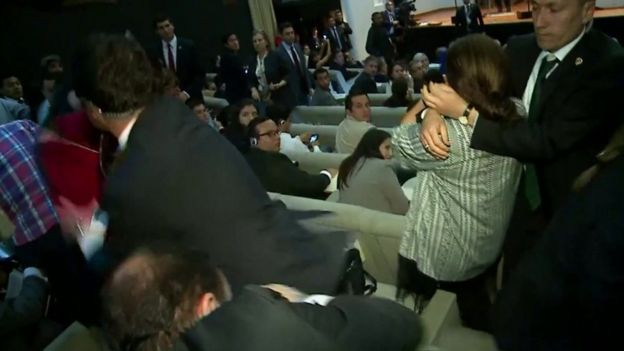
Three women protesters were thrown out of the venue by Turkish security. An Ecuadorean MP was also reportedly injured during Thursday's incident.
Ecuador's foreign minister says the guards' behaviour was "irresponsible".
Mr Erdogan was in Quito to boost diplomatic and trade ties with Ecuador.
As Mr Erdogan prepared to hold a news conference at the National Higher Studies Institute, protesters demonstrated against recent operations by Turkey against the Kurdistan Workers's Party (PKK) militant group.
Inside the hall, when the three women heckled Mr Erdogan, they were set upon by his personal guards and a scuffle ensued. One protester was momentarily placed in a headlock.
According to local media, a member of Mr Erdogan's security entourage attacked a protester as the Turkish president left the building.
And a member of the Ecuadorean National Assembly was reportedly injured while trying to protect the protesters.
Lawmaker Diego Vintimilla posted images on his Twitter account showing himself with cuts to his nose and hands and a bruise on his arm.
Envoy summoned
Ecuador said disproportionate force had been used by the security guards. Deputy Foreign Affairs Minister Fernando Yepez has summoned the Turkish ambassador in Quito, urging him to explain the violence.
Ecuadorean Interior Minister Jose Serrano said police had requested that the bodyguards involved in the incident surrender their passports on Friday.
However, Mr Erdogan and his entourage have since left the country. No comments from his government over the incident have been reported.
The PKK is considered a terrorist group by Turkey and its Western allies and has fought a 30-year insurgency in south-eastern Turkey in which tens of thousands of people have been killed.
There have been repeated clashes between PKK separatists and the Turkish army in recent months, and the violence has recently escalated.
Turkey has previously dismissed claims by the PKK that the government is attacking it "to stop the Kurdish advance against Islamic State [in Syria]".
While passing over the Rocky Mountains, an astronaut aboard the International Space Station took this photograph of the Great Salt Lake and the Bonneville Flats. As seen from orbit, the lake is unique because its two halves are different colors and because the railroad causeway that divides it is aligned exactly east-west.
Cities are hard to detect in daylight views from space, and so Salt Lake City is almost invisible. (Compare it to thisnight view.) The small rectangular patterns on both sides of the lake are evaporation ponds, from which various salts are collected in commercial operations.
The construction of the railroad causeway completely altered the original circulation of this shallow desert lake, and only two small culverts now join the two halves. As a result, the waters on either side have different salt concentrations and temperatures—an effect that becomes apparent in the color difference. The north basin (right) is saltier, and the salt-loving algae color the water shades of red. The south basin (left) is less salty and typically contains algae that color the water green.
From space, astronauts can see the Great Salt Lake as a remnant of a much larger body of water that used to cover the entire Bonneville Flats and other valleys in Utah. Water would have covered most of the view shown here except for the Wasatch Mountains and a few isolated peaks that would have appeared as islands. Ancient Lake Bonneville, as it has been named, was nearly as large as Lake Michigan and existed from 32,000 to 14,000 years ago. It formed during the last ice age when meltwater from numerous glaciers filled the basin and evaporation rates were much lower.
The white, salt-encrusted floor of the ancient lake has been used by racing enthusiasts for decades; the faint outlines of Bonneville Speedway appears near the top right. These flats are where many land speed records have been set.
Astronaut photograph ISS043-E-123891 was acquired on April 4, 2015, with a Nikon D4 digital camera using a 170 millimeter lens, and is provided by the ISS Crew Earth Observations Facility and the Earth Science and Remote Sensing Unit, Johnson Space Center. The image was taken by a member of the Expedition 43 crew. The image has been cropped and enhanced to improve contrast, and lens artifacts have been removed. The International Space Station Program supports the laboratory as part of the ISS National Lab to help astronauts take pictures of Earth that will be of the greatest value to scientists and the public, and to make those images freely available on the Internet. Additional images taken by astronauts and cosmonauts can be viewed at the NASA/JSC Gateway to Astronaut Photography of Earth. Caption by M. Justin Wilkinson, Texas State U., Jacobs Contract at NASA-JSC.
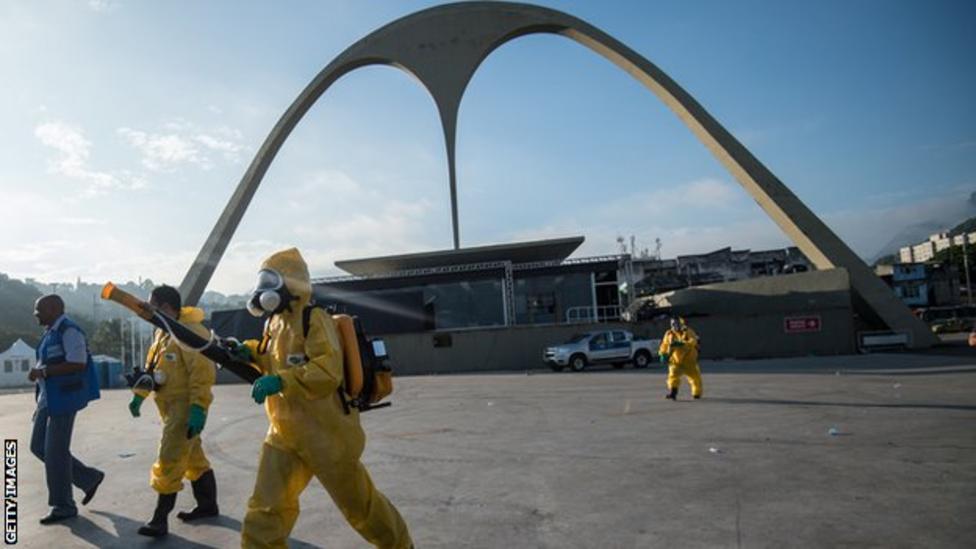
British Olympians have described the rapid spread of the Zika virus in Brazil as "devastating and "daunting".
Brazilian authorities said there was no risk to athletes and spectators, except pregnant women, at the Olympics which runs from 5-21 August in Rio.
"If it was me I'd be in a very uncomfortable situation," said ex-world badminton champion Gail Emms.
Britain's modern pentathlete Samantha Murray is set to compete in Rio and has been given medical assurances.
She said: "It is scary and daunting."
The World Health Organization (WHO) has declared the virus a global public health emergency.
"It's just devastating because this is something that's your dream and you want it to go perfectly," added Emms, 38, who won silver at the Athens Games in 2004. "You would feel frustrated, angry, and really worried about your friends and family.
"When I was going to Beijing [Olympics] I was 31 years old and I knew that was my last tournament before retiring, and I wanted to start a family. That would be playing on my mind.
"As a mother I can only just hope the best solution can be found quickly. I see the pictures and reports and I cry. It's just absolutely devastating."
The Rio 2016 organising committee has raised concerns about the rapid spread of the infection.
But a spokesperson said the Rio organisers have not yet seen evidence of people cancelling travel to the Games.
Communications director Mario Andrada added they will follow travel guidelines issued by WHO.
Britain's modern pentathlon Olympic silver medallist Murray will still be competing in Rio despite the concerns.
She told BBC Sport: "It is scary and daunting when looking at the news.
"It puts fear in everyone but as an athlete you get used to travelling around the world where you are at risk of infection. We have been assured by experts and Team GB and BOA that everything is being done to prepare the team.
"I have a chance at a second Olympics and I believe in the team around me and the medical team. I know I will be as best prepared. Hopefully I can be on the podium again."
David Sparkes , chief executive of British Swimming, said: "British Swimming is fully engaged with all relevant authorities and continues to brief the team based on the very latest advice.
"We will fully implement all advised measures, such as bite prevention strategies, to ensure the health and wellbeing of the team as this is our highest priority. This information will be continually reviewed and updated."
What is the Zika virus?
The infection has been linked to cases of microcephaly, in which babies are born with underdeveloped brains.
The biggest concern is the impact it could have on babies developing in the womb.
There have been about 4,000 reported cases of microcephaly in Brazil alone since October.
Currently, there is no vaccine or medication to stop Zika. The only way to avoid catching it is to avoid getting bitten by the Aedes mosquitoes that transmit the infection.
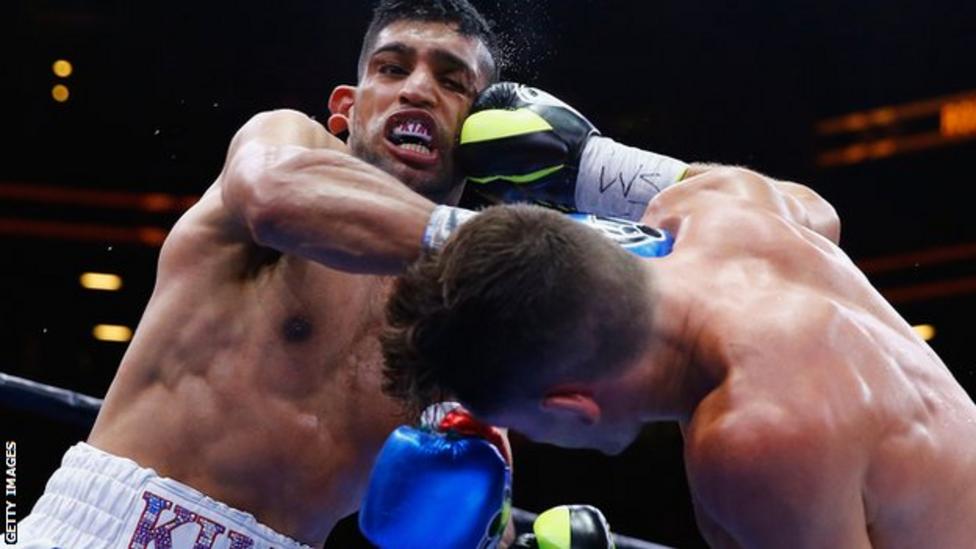
Britain's Amir Khan will fight Mexico's Saul Alvarez for the WBC world middleweight title on 7 May in Las Vegas.
Khan, 29, a former light-welterweight world champion, has not fought sinceoutpointing Chris Algieri in New York in May.
Alvarez, 25, beat Miguel Cotto by a unanimous points decision to claim the title in Las Vegas in November.
Alvarez has lost once and won 46 of his 48 fights.
The fight has been set at a catchweight of 155lb, eight more than Khan weighed in victory against Algieri and a jump of two weight divisions.
The usual weight limit for middleweight is 160lb, but Alvarez's last few fights have had the same weight stipulatioKhan's announcement also rules him out of a fight against IBF welterweight champion and domestic rival Kell Brook at Wembley on June 4.
"I know Canelo fights the best and wouldn't pass up the opportunity to face me like others have," said Khan. "My goal is to always fight the biggest names and the best fighters. That is why I'm excited for this fight.
"I know I have the speed and ability to beat him and will give my fans what they deserve."
"As the middleweight champion of the world, I will take on the best fighters in the sport and on Cinco De Mayo weekend, I look forward to making the first defence of my titles," said Alvarez.
"Amir was a decorated amateur, a two-time world champion and is in the prime of his career. Fans are in for a great fight."
Khan has won 31 and lost three of his 34 professional fights.
The pull of gravity on a distant star can now be measured more accurately, shedding light on other worlds, say astronomers.
The method makes it possible to study even the faintest of stars.
"Our technique can tell you how big and bright is the star, and if a planet around it is the right size and temperature to have water oceans, and maybe life," said Prof Jaymie Matthews.
Surface gravity is the intensity of the force that pulls everything on the surface of a star or celestial body towards the centre.
It is usually calculated by measuring a star's light or brightness - but this only works well for the closest, brightest stars.
A team led by Thomas Kallinger of the University of Vienna used data from theKepler space telescope - which is searching for other worlds like the Earth - to show that variations in the brightness of distant stars can give more accurate measurements of surface gravity.
The timescale of turbulence and vibration at a star's surface, based on its brightness variations, tells you its surface gravity, say the researchers.
Future space missions will hunt for planets around distant stars that might be capable of harbouring liquid water oceans and perhaps life.
The method can be applied to data from these searches to help understand the nature of stars like our Sun and to help find other planets like our Earth, says Dr Kallinger.
Earth-sized world
Since surface gravity depends on the star's mass and radius, the method should also help astronomers work out the masses and sizes of distant stars - and any planets circulating around them.
"If you don't know the star, you don't know the planet," said co-researcher Prof Matthews of the University of British Columbia, Canada.
"The size of an exoplanet is measured relative to the size of its parent star.
"If you find a planet around a star that you think is Sun-like but is actually a giant, you may have fooled yourself into thinking you've found a habitable Earth-sized world. "
UK soldiers who fought in the Iraq War may face prosecution for war crimes, according to the head of a unit investigating alleged abuses.
Mark Warwick said there were "lots of significant cases" and that discussions would be held over whether they met a war crimes threshold.
Lawyers are continuing to refer alleged abuse cases by soldiers to the Iraq Historic Allegations Team (IHAT).
The Ministry of Defence said it took such allegations "extremely seriously".
Two public inquiries have already looked at claims against UK troops in Iraq.
Mr Warwick, the former police detective in charge of IHAT, told the Independentthe allegations being investigated included ones of murder.
He added: "Over the next 12 to 18 months, we will review all the caseload to better understand the picture and then I think we can say whether 2019 seems realistic."
The inquiry has considered at least 1,515 possible victims, of whom 280 are alleged to have been unlawfully killed.
'Wholly unacceptable'
He said: "We would look at the credibility of the allegation in the first instance and, when we've looked at a lot of these extra cases coming to us, some of them are duplicates of cases, some of them we've already identified as part of our own investigation process, and some are multiple allegations, where we would investigate as a single allegation."
IHAT's budget of £57.2m runs until the end of 2019 - 16 years after the invasion of Iraq began in 2003.
BBC political correspondent Chris Mason said Mr Warwick's comments may have been a response to an interview by Michael Fallon in the Telegraph.
In it, the defence secretary said soldiers were inhibited on the battlefield because they feared "ambulance-chasing British law firms" would haul them in front of the courts on their return.
Carla Ferstman, director of the human rights charity Redress, also told the newspaper that the "incredibly slow pace" of IHAT's investigations was "wholly unacceptable".
He added: "Things seem to still be moving at a snail's pace. We call upon the government to ensure IHAT can, and does, do what it was set up to do, and to do it now. This cannot be a whitewash."
Colonel Richard Kemp, a former army commander in Afghanistan, agreed that the investigation needed to be completed urgently, but said it was "inconceivable" that that number of allegations against British troops could be legitimate.
"Of course one has to be concerned about these allegations, but the number, the sheer number, thousands of allegations made against British soldiers in Iraq, I just cannot believe that any significant number of them can be valid," he told BBC Radio 4's Today programme.
'Corporate failure'
A spokeswoman for the Ministry of Defence said most members of the armed forces behaved correctly.
She added: "The vast majority of UK service personnel deployed on military operations conduct themselves professionally and in accordance with the law.
"Where there is sufficient evidence, members of HM Forces can be prosecuted. It is estimated that the Ihat's work will take until the end of 2019."
An inquiry into claims of abuse by UK troops in Iraq highlighted the death of 26-year-old hotel worker Baha Mousa, who died in UK military custody in September 2003.
It concluded in September 2011, with inquiry chairman Sir William Gage blaming "corporate failure" at the Ministry of Defence for the use of banned interrogation methods in Iraq.
The Al-Sweady Inquiry, set up in 2009, followed allegations made in judicial review proceedings at the High Court that the human rights of several Iraqis were abused by British troops in the aftermath of a firefight with insurgents near the town of Majar al Kabir.
Inquiry chairman Sir Thayne Forbes said allegations that troops murdered and mutilated Iraqis in custody were "wholly without foundation". But he did conclude that some of the detention techniques had amounted to mistreatment.